
3 Exercises to help you set and achieve your 2026 goals:

Big new year, new me goals are easy to write down in late December. Following through in February, May, and October is the hard part.
These three exercises shift goal-setting away from vague motivation and towards structure, clarity, and daily behaviour changes that will keep you in alignment with your goals. Ensure your goals align with your values.
Get you ticking off those goals throughout the year.
EXERCISE 1. Reflection.
Before you plan, ensure you reflect and audit your last year (or two) and current life…
Here are some key reflection questions to get you started:
1 - What did I achieve, and worked well this past year (in training, work, my relationships, my lifestyle, etc) — and why?
2 - What didn’t work, and what kept showing up as a problem or barrier?
3 - What moments in 2025 did I feel content, and happy? What was associated with that feeling? (i.e., what habits were I doing regularly? how was I spending my time, what was I doing? Who was surrounding me?)
Start With Values: The Missing Piece in Most Goal-Setting
Most failed goals aren’t unrealistic — they’re misaligned.
We set goals based on what we think we should want: what other athletes are doing, what looks impressive on Instagram, what we’ve done before, even if our life has changed…
When goals don’t match your values, this misalignment creates friction. And potentially disappointment, because you don’t achieve them.
What does it mean to align goals with your values?
The definition of value : the regard that something is held to deserve; the importance, worth, or usefulness of something.
Your values are the things that matter most to you. They represent who you are as a person, and should reflect how you spend your time, and what you put your energy into.
FOR EXAMPLE: I value:
Flexibility in my day
Autonomy in my work life
I enjoy having my hands in multiple cookie jars (work, training, study, art, relationships, music, etc etc)
I want freedom to train 1-2 hours per day, no. matter. what.
There’s no “correct” set of values — but there is a cost when your goals ignore them.
Pressure-test your goals. For every goal you set, ask yourself:
Does this support my values — or compete with them?
What am I not willing to sacrifice for progress towards my goals?
What value does this goal actually serve?
Your values (and therefore your goals) may shift over time. And that is totally fine. One question I have plastered on my wall is this:
HAS THE MOST IMPORTANT THING CHANGED?
AM I CHASING AN OUTDATED TARGET?
A year is a long time. Life (and your goals) may change shape and meaning over that timeframe. And that’s okay - Progress doesn’t disappear when priorities change. It just may need some re-evaluation.
How This Connects to the Rest of Your Goals
Once your values are clear your superordinate goals make more sense and your ideal week becomes realistic and your daily habits feel purposeful.
Values are the anchor. And goals help you to build structure and habits around them.
EXERCISE 2. Design Your “Ideal Week” (Then Reverse-Engineer It)
Instead of forcing goals into your current chaos, flip the script:
What would your ideal week look like if training, work, recovery, and life were actually in balance? This is about setting and viewing the intentional structure of your life, and seeing what needs altering or changing in order to move you closer to your ideal life.
Step 1: Map your ideal week
On paper (or in a notes app), outline: training days, work commitments, non-negotiables like friend, family, social, or downtime. You could even map our your meal, sleep and wake times if that is something you are focusing on in 2026.
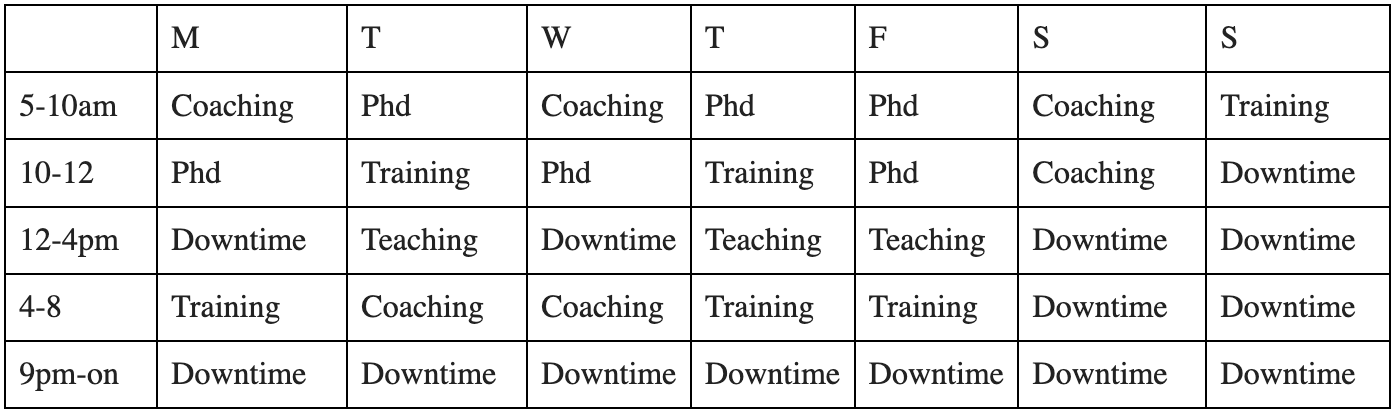
Make it as in-depth as you want. For example, the skeleton of my “ideal” week is below. But a more in-depth view may delve into what down-time looks like (i.e.,for me this time allows for all of my non-negotiables like time with friends or family, or reading, being creative, or chilling on the couch - dependant on the day/ my energy levels).
And this may change, so you will be flexible with how it looks week to week (and hour to hour),but this gives you something to aim for! And ensure your goals are in alignment with what you want your life to look like.
EXAMPLE:
Ask yourself:
What is non-negotiable? (most likely some structured work hours)
Where is there friction?
What consistently gets skipped, pushed to the side, or rushed?
What feels unrealistic?
Then build goals that move you towards that week:
Rather than just saying “train more,” this = Move two sessions earlier in the day so they definitely get done
If you want to cook more from home = Add in a time slot to prepare meals twice per week instead of daily stress cooking
The goal isn’t to suddenly live your dream week, it’s to close the gap between where you are now and where you want to be.
EXERCISE 3. Now it’s time to write out your 2026 goals
I view goal setting from this lens:
Superordinate goals (your big picture, these goals underpin your values and lifestyle, and who you are as a person. Your “why”. And these may be never ending.)
Mid-term goals (what moves you closer to your superordinate goal, but may change from month to month, or year to year)
Short-term goals & daily habits (what you actually do day to day)
Superordinate goal (your “why”): This is the big, values-based outcome. It’s broad and long-term.
Examples:
“Be a strong, capable athlete for the long term”
“Live a life where training supports my health”
“Perform confidently on the platform”
Mid-term goals (what moves you closer): These are more specific and time-bound.
Examples:
Add 10kg to my back squat in 2026
Train consistently 4x/week for the next 6 months
Improve technical consistency in the snatch
Short-term goals & daily habits (what you actually do): This is where goals become actionable.
Examples:
Follow my program as written
Go to bed by 10:30pm on training nights
Complete accessories instead of skipping themEat protein at every meal
If a daily habit doesn’t clearly support a higher-level goal, it’s noise.
These exercises will help you stop chasing random goals and start building alignment between your values, your schedule, and your daily behaviours.
Reflection
Design your ideal week
Clarify your goals matter
You give yourself a much better chance of actually showing up in 2026 — long after the New Year hype fades.
—MWBC Coaching Team
