
Performance Anxiety as a Weightlifter: What Does It Mean?

It’s competition day. You've hit this lift a hundred times in training. Now your hands are shaking, your mind goes blank, and suddenly you can't remember how to do the thing you've spent months training.
You know you get nervous before competing, you always have. But, you hope that maybe this time will be a little different. The nerves often feel like a problem, often making us want to avoid the competition all together, hope it’s over, or worse become so anxious that you can’t keep food down when you’re trying to fuel a platform PB!
The goal isn’t to eliminate anxiety (although wouldn't it be nice?), it’s to understand it and know what you can do to work with it.
Hi, I’m Emma, an Accredited Mental Health Social Worker with a background in sport social work that works with athletes to support their mental health and performance. Across a small series, I’ll be covering everything you need to know about performance anxiety as a weightlifter.
What we’ll cover here: What performance anxiety actually is, how it shows up for weightlifters, and what you can do about it.
What is performance anxiety, actually?
Performance anxiety is what happens when the demands of a situation start to feel bigger than your ability to handle them. The psychological stress we might feel in weightlifting might look like standing behind the platform knowing the weight on the bar is one you've hit before, and suddenly feeling like you have no idea if you can do it again.
There are 6 categories of psychological stress as it relates to performance:
- Fear of failure (ex. making a foolish mistake, bombing out, missing your opener)
- Feelings of inadequacy (ex. getting tired, failing a weight you can do no problem, comparing yourself to others in the backroom)
- Loss of internal control (ex. referee decisions, weigh-in worries)
- Concern about the expectations of others (ex. family or friends watching, teammates, coaches)
- Poor preparatory training and physical state (ex. getting sick, injury, struggled hitting planned openers in training that week)
- The media and unforeseen events (ex. social media posts before the event, filming of attempts)
There are two ways anxiety presents:
Mental worry: Fear of failure, doubt, racing thoughts ->can show up days or weeks before a comp.
Physical symptoms: Racing heart, shaky hands or legs, tight chest, nauseous stomach ->all peak closer to the event.
In weightlifting, this might look like wanting to pull back on the planned number jumps for the session, feeling so flooded with worry or physical anxiousness that you “black out” on the platform or feel out of control over your body. It might make you even feel hyperaware of your body, what it’s doing, and affect the trust you have in your body to complete a lift.
While these experiences might not perfectly describe your experience, performance anxiety is incredibly common among athletes, and again the way we deal with it doesn’t come down to getting rid of it, it comes down to building your confidence in your ability to cope with the anxiety.
What does this mean?
We seek to understand (what we’re covering here), plan, prepare, and plan some more (what we’ll cover next).
Not all nerves are the same
Now that we understand that performance anxiety is rooted in belief and confidence, not the intensity of the anxiety itself it’s important to know why.
Anxiety can be either debilitative when athletes believe they can't cope or won't achieve their goal or facilitative when they believe they can.
Let’s use the example of two lifters:
Lifter 1: Shakes before every attempt, notices the shaking, knows it’s a physical sign of anxiety, they follow their mental set-up routine, and still hits a PB.
Lifter 2: Shakes before the attempt, notices the shaking and starts to spiral about what that means for the lift, “If I’m shaking, then I won’t be able to get the weight up, everyone is looking at me, what if it feels heavy? What if I can’t even pull it off the ground?”
The PB doesn’t happen because one lifter is calmer than the other, it’s that they understand what’s happening in their body, they know anxiety be present, that they might even need a certain amount of it, and they can still perform without pushing it away or letting it take over; all because they have a routine, they’ve practiced it, and they trust that they can cope with whatever comes up.
We Might Need Some Anxiety: Finding Your Zone
You’ve probably heard before about the Zones of Arousal for athletic performance.It’s the idea that too much mental worry and too many physical symptoms of anxiety (arousal) can negatively affect performance, and too little mental and physical anxiety (arousal) can negatively affect performance. Ideally, finding the sweet spot between the two or the optimal zone of arousal to perform.
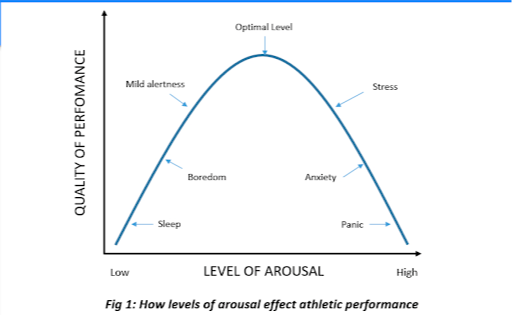
The important thing about Zones of Arousal is that every athlete is going to have their own optimal arousal on that curve, and it might vary depending on what they’re doing. We call this the Individual Zones of Optimal Functioning (IZOF).
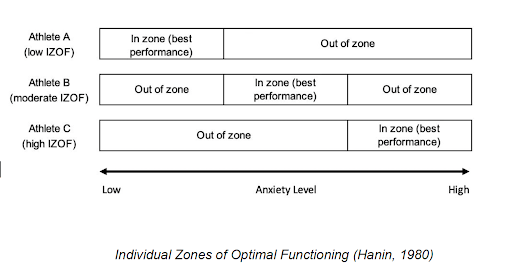
Some lifters might need high arousal to perform their best, some might need low. But, neither one is wrong, it’s about what you need to perform at your best.
Reflection: Take a second to think here, what kind of arousal state do you perform at your best? What do your body and your brain feel like when you’re performing at your best in training?
What kind of state are you in when performing your best snatches or clean and jerks? Think back to your best competition, what felt different? And is your optimal arousal look different depending on the lift you’re doing?
Action: Before we can know what your own optimal arousal level is, we need the information!
1. Before every training session, in your training journal or in your spreadsheet, write down how you rate your arousal on a scale of 1-10 (1=low/could sleep, 10=panic).
2. At the end of the session, reflect on how you performed, did it feel optimal to you? Did it sustain or dip throughout the session? Was there anything that helped you increase or decrease your arousal?
3. Keep the information you collect and reflect on so that in the next blog we can make a plan to approach your training and competition.
Conclusion & Next Steps -> Plan, Prepare, and Plan Some More.
If you’re experiencing performance anxiety as a weightlifter, know that it’s incredibly common and that it’s your body and brain's way of signalling that this is important to you.
Performance anxiety can be addressed, but it starts with acknowledging that it's there. The goal isn't to push it away or pretend it doesn't exist, it's to build the tools and confidence to know you can handle it. Part of that process is identifying the level of arousal you personally need to perform at your best. With a little observation and reflection, that sweet spot is more findable than you might think.
In the next blog, we’ll look at how we incorporate our optimal arousal into training and competition, and how we can bring in some routine and certainty into an uncertain environment.
About the Author
Emma is an Accredited Mental Health Social Worker with a background in sport social work and athlete mental health. As a former competitive figure skater and current amateur weightlifter, she draws on both lived and learned experience to support the athletes she works with. She is the founder of Ryse Wellbeing, a mental health service based in Melbourne, specialising in the mental health, neurodiversity, and wellbeing of athletes. Emma works with young athletes navigating the psychological demands of competitive sport.
Book a consult at rysewellbeing.com.au
References:
Beilock, S. L., & Gray, R. (2007). Why do athletes choke under pressure? In G. Tenenbaum & R. C. Eklund (Eds.), Handbook of sport psychology (3rd ed., pp. 425–444). John Wiley & Sons.
Cohen, S. (1986). Contrasting the Hassles Scale and the Perceived Stress Scale: Who's really measuring appraised stress? American Psychologist, 41(6), 716–718.https://doi.org/10.1037/0003-066X.41.6.716
Furley, P. A., & Memmert, D. (2010). The role of working memory in sport. International Review of Sport and Exercise Psychology, 3(2), 171–194.https://doi.org/10.1080/1750984x.2010.526238
Hanin, Y. (1995). Individual zones of optimal functioning (IZOF) model: An idiographic approach to performance anxiety. In J. H. Salmela (Ed.), Sport psychology: An analysis of athlete behavior (3rd ed., pp. 103–119). Mouvement Publications.
Hanin, Y. (1997). Emotions and athletic performance: Individual zones of optimal functioning model. European Yearbook of Sport Psychology, 1, 29–72.
Jones, G. (1995). More than just a game: Research developments and issues in competitive anxiety in sport. British Journal of Psychology, 86(4), 449–478.https://doi.org/10.1111/j.2044-8295.1995.tb02565.x
Wadey, R., & Hanton, S. (2008). Basic psychological skills usage and competitive anxiety responses: Perceived underlying mechanisms. Research Quarterly for Exercise and Sport, 79(3), 363–373.https://doi.org/10.1080/02701367.2008.10599500
