
Stop spiralling after a miss: Building your reset routine as a weightlifter
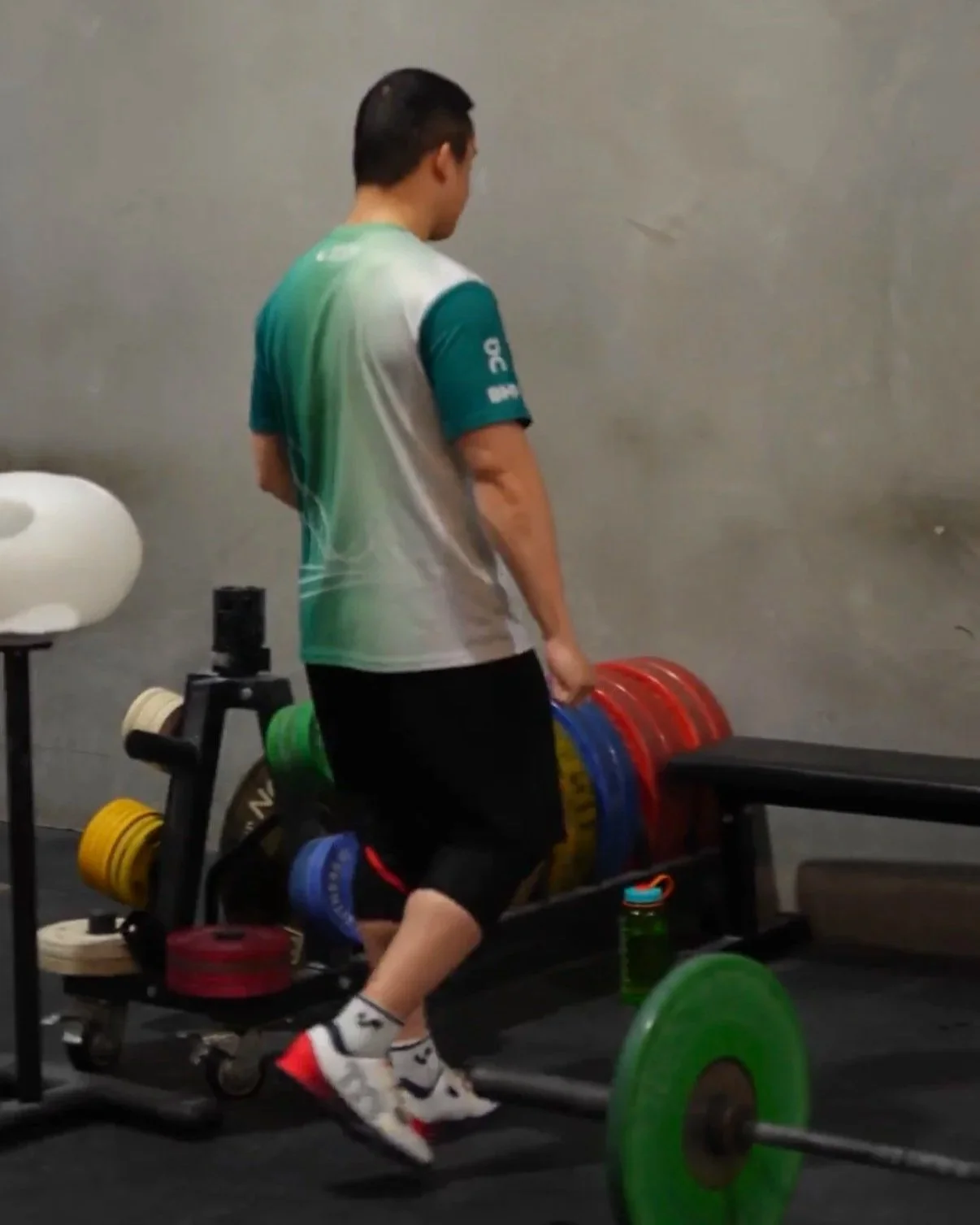
The performance routine gets you into an attempt.
The reset routine is what you do in between lifts to make sure every attempt gets the same focus and intention.
Athletes often do a tremendous job at their preparation and even post-training or competition reflection, but what they’re often missing is how to reset in between.
A reset routine can help make the difference between whether a missed opener takes over the whole session! Because what actually happens after a miss, for most lifters, is the replay starts, the self-talk turns, anxiety spikes mentally and physically, and you take your second attempt while still mentally standing in your first.
If you’ve ever thought “I just need to get it together”, “I’m terrible at this”, “I’m going to bomb out now”, “I knew I couldn’t do it”, “Everyone saw that”, you’re not alone, it’s common that when we care about things and our brains run on the anxious side, we can be quick to jump to automatic negative thoughts.
The great thing about these automatic thoughts is that we can change them! So, let’s fix that 👇.
If you’ve been following along with this series of posts I’m writing for MWBC to help our athletes ease their anxiety in the gym and on the competition floor, you’ve already learned how to prepare yourself for training and competition, and what to do about performance anxiety if it’s taking over!
I’m Emma, an Accredited Mental Health Social Worker that works with athletes to support their mental health and performance. Across a small series, I’ll be covering everything you need to know about building the mental skills you need to perform as a weightlifter.
The mindset shift
Learning a sport is hard. The odds of someone picking up a barbell for the first time and being able to complete a snatch or clean and jerk perfectly would be impossible. MANY hours go into learning a skill, so it's important to remember that when you’re weightlifting. Of course, every rep isn’t going to be perfect (how boring would that be?) and of course you’re going to miss sometimes. If you weren’t missing, I’d actually be worried you might not be challenging yourself.
When in doubt, use evidence
If you need more convincing, think about it from a numbers perspective…If you do complete 10 reps of a snatch 2x per week, that’s 1000 snatches you across a whole year. If you miss one snatch per week, that’s 52 snatches across a whole year.
Are you going to focus on the 5% of snatches you missed, or the 95% of snatches you made?
Another sport’s perspective
I love to use the example of figure skating in this context because I can attest (as a retired figure skater that did nothing but fall 80% of the time), figure skaters spend a significant amount of their training falling. They might make 20 attempts at a new jump, and fall every time. They might even leave a session without landing one that day. The difference is, figure skaters expect to fall. They even prepare by buying padded shorts to soften the impact!
What I’m getting at here is, expect to miss, and I don’t mean when you’re walking up to the bar before you lift. I mean, when you miss, it’s a part of learning and practicing a skill, and it shouldn’t come as a surprise to you that it can happen sometimes! A miss doesn’t mean anything about you, how good you are, or your future as an athlete.
So, if you’re going into training with the goal of not missing a lift, you’re doing yourself a disservice. Consider missing a neutral and integral part of your training!
The goldfish memory
A goldfish, so the story goes, has a three-second memory. Every lap of the bowl is the first lap. Every moment arrives clean. It's meant as an insult, but as a lifter standing over your second attempt, it’s a tactic. You can’t focus on what you’re doing if your head isn’t where your feet are. The miss from ninety seconds ago doesn't exist, and neither does the attempt you just absolutely crushed. The third attempt you're already worried about also…doesn't exist.
The next time you miss a lift in training, practice walking away from it physically AND mentally. Your only job is to prepare for the next lift.
What’s happening in your body
To understand why a reset routine works, it helps to know what you're resetting.
When you’re lifting and as your arousal increases to your optimal level, so do the chemicals in your brain that bring that arousal. Norepinephrine and cortisol start to increase in your brain, while simultaneously the blood flow to your frontal lobe (problem solver, planner, rational brain) slows.
It’s integral that we have a routine in place that helps our brain and body reset by redirecting our focus, calming our body after exertion, and reducing muscle tension (so you actually rest). We need one that doesn’t take a lot of thinking to implement and that’s practiced so it becomes second nature.
The four steps to reset after every lift
A reset routine is a deliberate sequence for closing one attempt and opening the next. It uses the same tools as your performance routine; a physical anchor, breath, and a focal point.
1. A physical action that marks the end. Unstrap, walk to a set spot, sip water. Try one consistent action that means that attempt is finished. Athletes describe exactly this in the research as a small ritualised sequence that closes one moment and opens the next. This works because of conditioning: a physical action paired with the same meaning, repeatedly, becomes a habit. Your body learns that this movement means done, in the same way it learned that your chalk-up means go.
2. Use your breath. The mechanics here are simple: a slow exhale, longer than the inhale, activates the parasympathetic nervous system to reduce muscle tension, and slow your heart rate down.
3. Choose your focal point. Choose where you’re going to anchor your attention between lifts. Is it going to be listening for your breath? Or will you choose something specific to look at between lifts while you breath? Will it be close to you or far away?
4. Return to your performance routine. The reset ends where the next attempt begins. Using the same pre-lift routine you established in our last post!
Training it
The wonderful thing about mental performance skills is that they’re trainable! One approach from mental skills work: write down your most likely distractions like a miss, a judge's call, someone filming, a loud warm-up room. Decide in advance if there’s any adjustments you might need to make to your reset for each instance. Then have your coach deliberately throw those distractions at you in training, without warning, so you practise resetting under real conditions.
Where self-talk fits
Self-talk runs through all parts of your performance: before performance (your routine and cue word), during performance (your performance cues), and after performance (what worked, what to adjust). What we don’t want is to let self-talk turn into reflection mid-training or competition. (Remember, our brains aren’t in rational thinking mode). So, be sure to observe yourself, are you evaluating mid-session, between attempts, or on the platform? Take note, and practice using your reset routine to bring yourself back to what you’re doing. Use your time after the session’s over to reflect.
Putting it all together
From here you’ve got a strategy to support missed lifts in training or competition regardless of the circumstances. Use these tools to implement into your training and reflect on what feels most helpful vs. what doesn’t.
Most importantly, remember that misses happen, especially when you’re trying to lift a heap of weight over your head!
About the Author
Emma is an Accredited Mental Health Social Worker with a background in sport social work and athlete mental health. As a former competitive figure skater and current amateur weightlifter, she draws on both lived and learned experience to support the athletes she works with. She is the founder of Ryse Wellbeing, a mental health service based in Melbourne, specialising in the mental health, neurodiversity, and wellbeing of athletes. Emma works with young athletes navigating the psychological demands of competitive sport.
