TRAINING: AUTO REGULATION – WHAT THE F#K IS RPE?
So, you’ve just got eyes on your new training program, and your coach has prescribed this thing called RPE. What does it mean?
RPE stands for Rating of Perceived Exertion and is the manipulation of load or intensity based on your individual perceived effort and performance. At its core, RPE is a way of adjusting load based on how hard a set actually feels, rather than forcing yourself to lift a pre-determined weight no matter what.
Because you are not a robot. The weight you can lift and the weight you should lift changes depending on a lot more than just what’s written on paper. Using RPE to adjust load or intensity takes into account the human who walked through the gym door and is all-encompassing of:
Your objective performance (what is actually happening, how fast the bar is moving, the quality of your movement)
Subjective motivation, focus, and readiness
Level of recovery (e.g., soreness, overall fatigue)
Level of conditioning (readiness to perform what is programmed)
Influence of non-training related stressors (e.g., sleep, nutrition, workload, family commitments)
Some days, 50kg will feel like an RPE 7. Other days, it’ll feel like an RPE 9. RPE gives you permission and structure to adjust accordingly.
Benefits of Appropriately Using RPE
Using RPE can:
Allow for individual, on-the-spot adaptation to training load, and even rest periods
More closely match the intended training stress and progressions, with readiness and recovery taken into account
Enhance psychological outcomes such as exercise adherence and enjoyment
RPE can also be an indicator of progression over time. For example, if you complete 3 back squats at 100kg at an RPE of 9, but then complete 3 reps at 100kg at an RPE of 7 three months later, this is progress!
RPE/RIR Scale
The RPE/RIR scale used as the main measure of intensity and effort goes from 1-10:
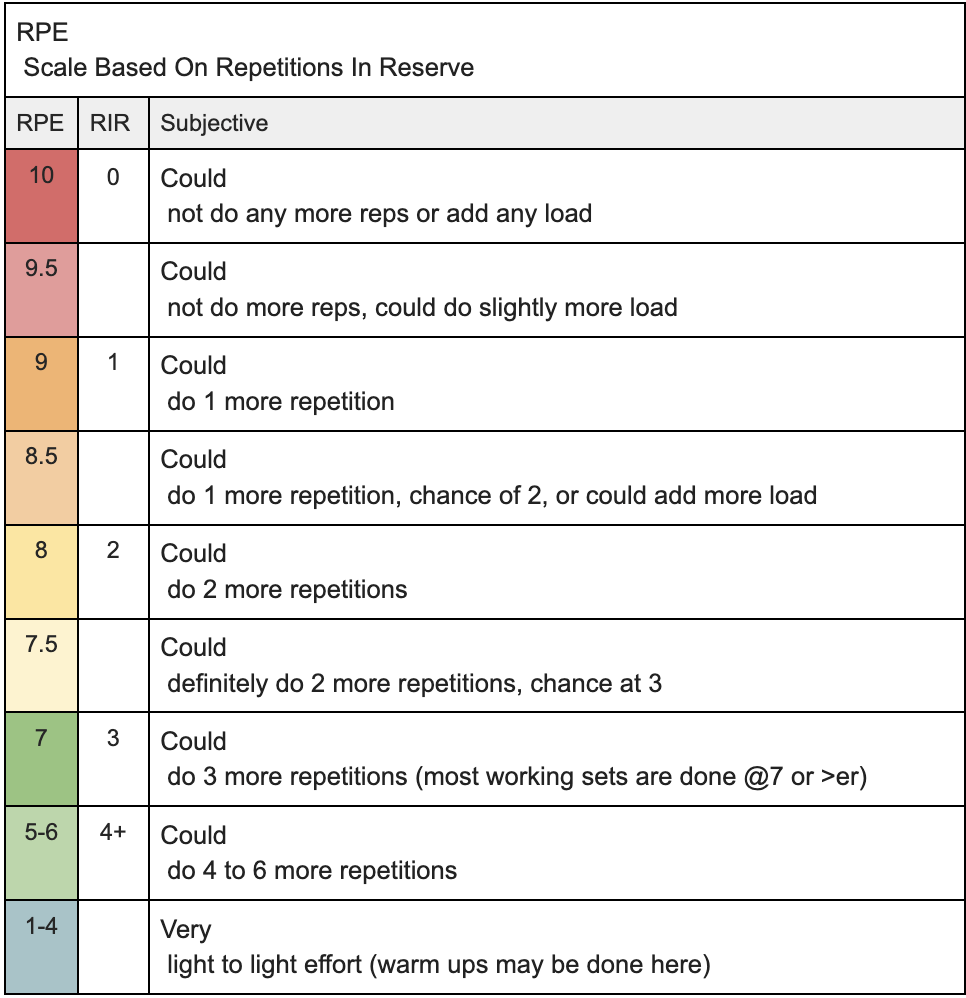
RPE and RIR have an inverse relationship. When using this scale, values are based on how close to failure you get at the conclusion of each set.
An RPE of 10 would be at failure = 0 RIR; no additional load or reps could have been performed.
A 9 RPE would be one RIR, an 8 RPE would be two, and so on. Everything is based on how close you are to failure at the end of the set.
Most of your training (especially as a beginner) will live around the RPE 5–8. This means you are working hard, but you are not going to failure. You are leaving reps in the tank, and your technique stays consistent.
Example: What RPE Looks Like in Real Life
Let’s say your program says: Back Squat for 3 sets x 6 @ RPE 7. That means you pick a weight and complete 6 reps. At the end of the set, you should feel like you could have done ~3 more reps or added some more load to the bar. There is still something left in the tank, but not so much that the exercise gave you no stimulus.
RPE as a Skill
RPE is a skill—and like any skill, our ability to accurately gauge RPE and RIR takes practice.
RPE can be hard to use initially, but it involves you listening to your body and not just trying to overload the weights each and every week. Experienced lifters are very accurate when estimating RIR. If you aren’t an experienced lifter, next time you are hitting your lifts that have a prescribed RPE, try the following:
Utilize your coach's guidance and ask for feedback on your lifting. If you think something is an RPE 8—check.
Record a video of a set and rate the RPE during the set and after watching the replay, adjust if needed!
Focus on the quality of your movement and the speed of the barbell from the very first rep of your set to the last. Quality should be maintained (especially at the start of your lifting journey), but if you are in the 7-8 RPE range, the speed of the movement is most likely going to be slower (and feel harder) towards the end of your set.
You won’t nail it straight away, and that’s fine. Over time, you’ll get better at reading your body, understanding effort, and making the right calls in your training.
Want Help Mastering Your RPE?
Learning to gauge your effort and adjust your training takes practice, but you don't have to figure it out alone. Our coaches are here to guide you through every rep, help you understand what an RPE 7 really feels like for YOU, and ensure your training matches your readiness each day. Ready to train smarter, not just harder? Book your free one-on-one session today!
—MWBC Coaching Team
